
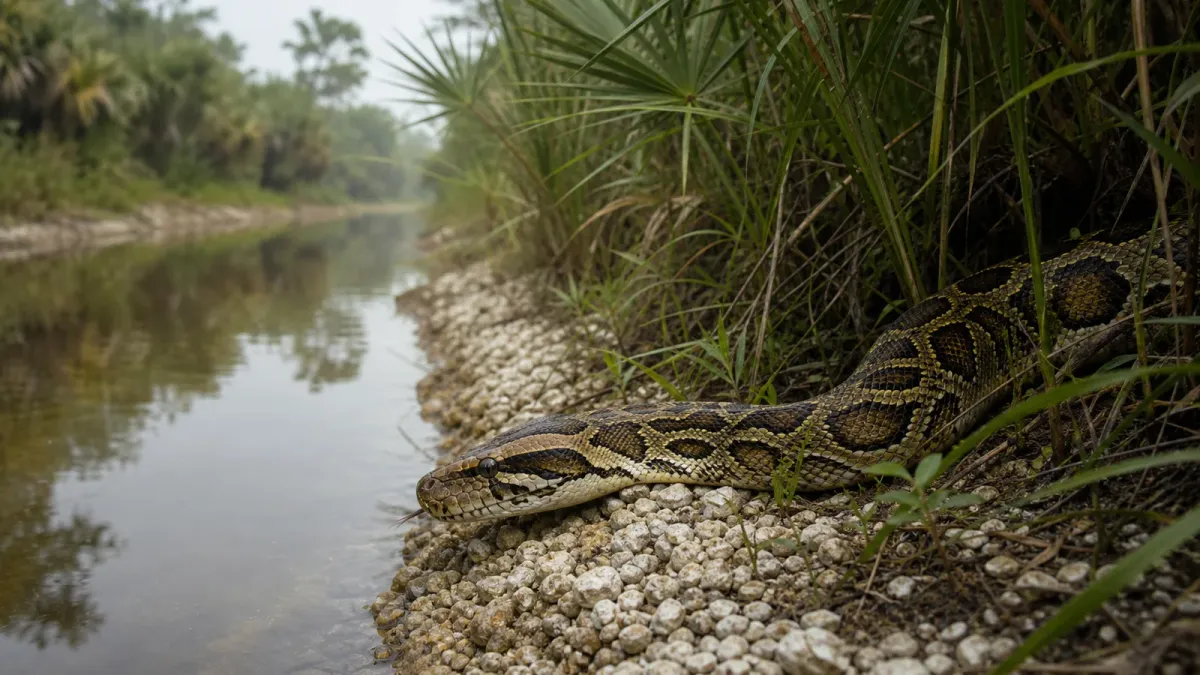
Burmese pythons have established a new foothold outside their historic Greater Everglades core, a range change that matters in Miami-Dade even though the newly confirmed population is on Florida's Gulf Coast.
The Florida Fish and Wildlife Conservation Commission told ABC News that the snakes are now considered established in part of western Charlotte County, north of Fort Myers. The agency said increased reports began in 2020 around Rotonda West, Placida, Englewood East and South Gulf Cove. Officials do not believe the snakes reached the area through natural migration; escaped or released captive animals are the likelier source.
The confirmation came as Florida held its 2026 Python Challenge from July 10 through July 19. The annual event focuses on removals in the Everglades, but the separate Charlotte County population shows that monitoring cannot stop at the competition zones or at the edge of the long-established range.
The short answer
This is not evidence that Burmese pythons are suddenly spreading through urban Miami. It is evidence that a damaging invasive predator can form a separate breeding population far from the best-known invasion zone—and that early reports outside a known range are important.
Miami-Dade remains central to the story. The FWC says Florida's established population was historically centered in Everglades National Park. The long-recognized range now stretches from just south of Lake Okeechobee to Key Largo and from western Broward County west to Collier County.
Why a satellite population is different
A satellite population can create a second front for wildlife managers. Instead of watching only the edge of one connected range, agencies must also search a separate area where the snakes are difficult to see. The U.S. Fish and Wildlife Service says the probability of detecting a Burmese python in the wild is less than 1%.
That low visibility makes population estimates unreliable. It also helps explain why the FWC says confirming a new area of establishment can take time. Pythons are well camouflaged, often stay near water and can move through wetlands, canals and other cover without being noticed.
The ecological stakes are substantial. Burmese pythons eat mammals, birds and reptiles, including protected species. Federal wildlife officials say they may also compete with native predators by reducing available prey. Adult snakes caught in Florida average 6 to 9 feet, while the largest captured in the state measured more than 18 feet, according to the FWC.
What Miami residents should do
If you think you see a Burmese python, keep your distance. Take a photograph if it is safe, record the exact location and report the sighting to the FWC immediately. Reports can be made through the IveGot1 app, at IveGot1.org or by calling 888-IVE-GOT1 (888-483-4681).
Do not release an unwanted exotic pet. Florida's Exotic Pet Amnesty Program accepts nonnative pets without penalties or questions, including animals kept illegally. The FWC says released pets remain a primary source of introduced species.
What to watch next
The FWC and partner agencies are continuing surveys and removals in Charlotte and Lee counties. In South Florida, researchers are also tracking pythons and nesting behavior to improve detection. The lesson for Miami is practical: a single report may not prove a new population, but a pattern of verified sightings can reveal a range change before it becomes harder to contain.


