
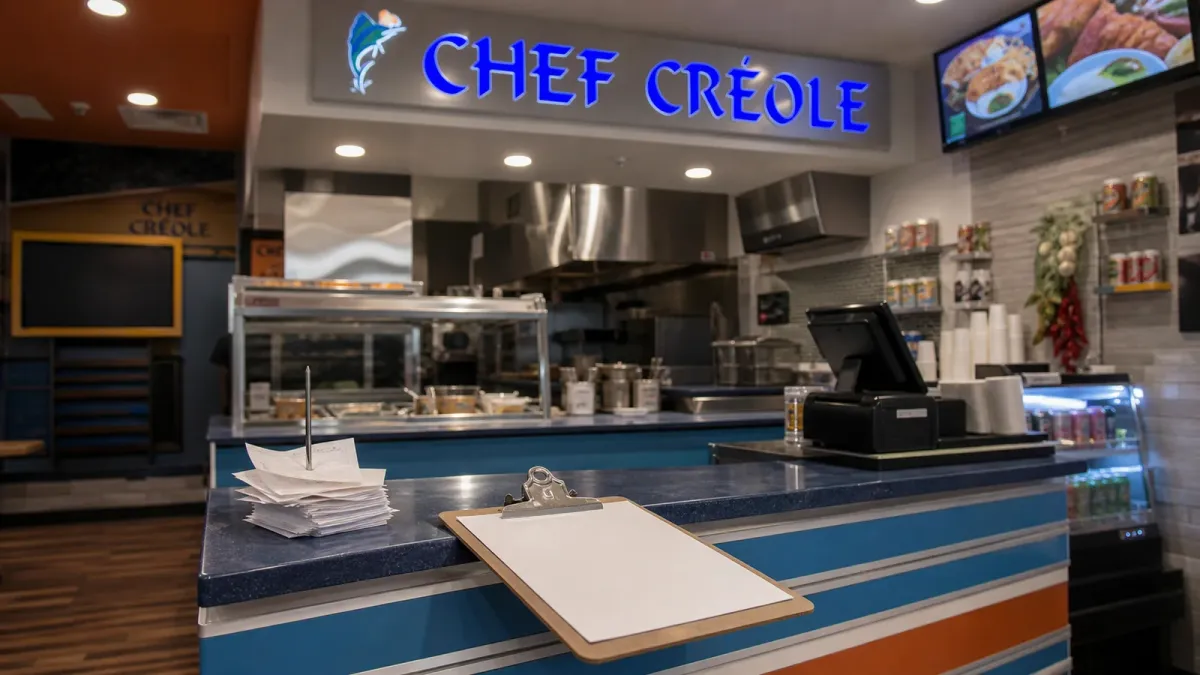
Chef Creole's immigration-policy story has moved from politics into the price of lunch in Miami. Owner Wilkinson "Ken" Sejour told Local 10 that the end of Haiti Temporary Protected Status work authorization has already cost the restaurant chain workers, chilled some customer traffic and forced him to rethink expansion.
The practical consequence for Miami diners is straightforward: if the labor gap lasts, Sejour says prices may have to rise. Local 10 reported July 29 that he had lost four employees and expected labor costs that were supposed to run at 23.5% to move toward 27% or 28%.
That turns a national immigration ruling into a local business test for a Haitian-Bahamian restaurant brand founded in Miami in 1992 and now operating seven Chef Creole locations across the city. The pressure is especially visible in Little Haiti, where Local 10 reported that immigration officers detained a scooter rider on August 2 near the drive-thru at 200 NW 54th St.
What changed
USCIS guidance reviewed July 29 says Haiti's TPS designation terminated effective July 27, 2026. The agency says certain Employment Authorization Documents issued to TPS Haiti beneficiaries are no longer valid, and employers must reverify affected workers before continuing employment.
The rule matters because restaurants cannot solve a work-authorization problem the way they would solve an ordinary vacancy. A trained cook, cashier or manager can leave a gap immediately, while replacement hiring, payroll checks and training take time. For a local chain with recognizable service rhythms, the disruption can reach customers quickly during lunch rushes and weekend service.
The Associated Press reported last week that the same work-authorization confusion is hitting employers beyond Miami, including restaurants, long-term care and construction. In Florida, AP reported that a Key West restaurant manager suspended six Haitian workers after checking federal employment records.
For Chef Creole, the local effect is not abstract. Sejour told Local 10 on August 8 that the labor shortage and fear around enforcement have made expansion harder. Earlier, he said the chain was looking for replacement workers and that higher labor costs could flow through to customers.
Why Miami should watch
Miami-Dade has one of the country's most visible Haitian communities, and Little Haiti businesses do more than sell food. They anchor jobs, foot traffic, cultural identity and neighborhood routines. A staffing shock at a well-known chain is a signal that the TPS change may show up in hours, service levels, hiring and prices before it appears in broader economic data.
It also gives Miami a concrete way to measure a policy whose effects are often discussed nationally. If a neighborhood restaurant has to change staffing, slow growth or charge more, the impact is no longer theoretical for workers, customers or nearby small businesses.
The story is still developing. The federal work-authorization rule is now in effect, but employers and workers are adjusting in real time. For diners, the immediate thing to watch is whether Chef Creole changes hours, pauses expansion plans or raises menu prices as it replaces workers.


