
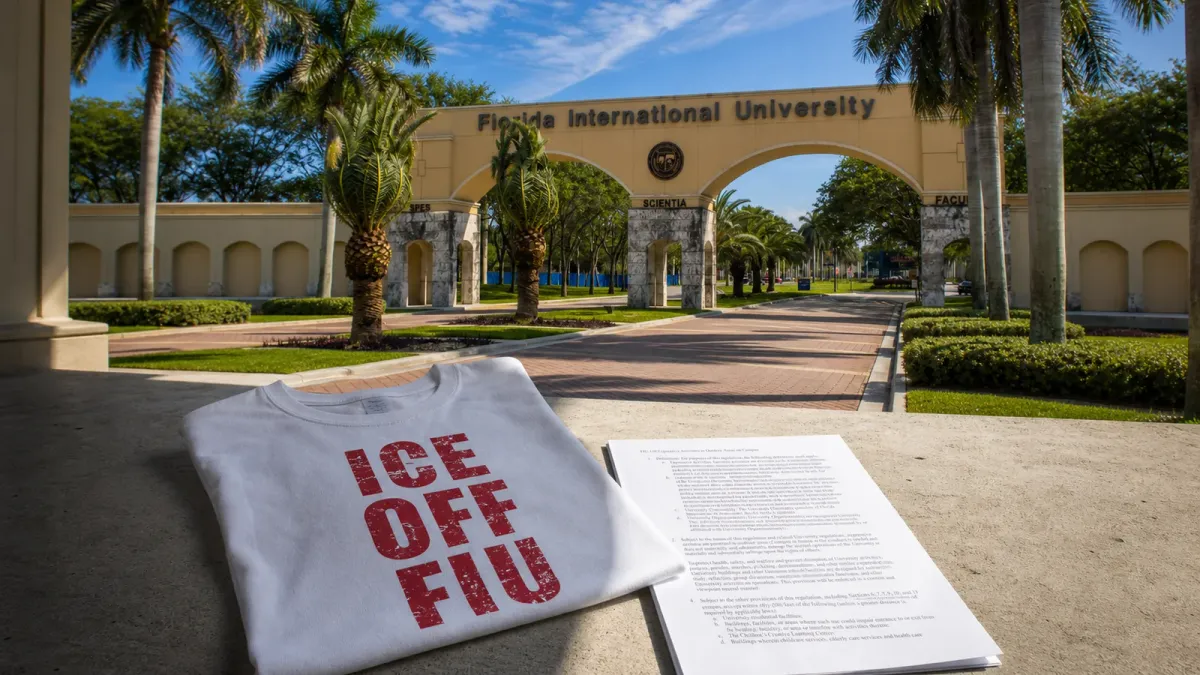
A federal judge in Miami is weighing whether Florida International University may enforce discipline against seven students who silently protested the school’s cooperation with U.S. Immigration and Customs Enforcement. The students are seeking a preliminary injunction as FIU’s fall term begins Monday, August 24.
The immediate question is narrow but consequential: whether FIU can keep applying its indoor-expression rule and the sanctions imposed on these students while their First Amendment lawsuit proceeds. A preliminary injunction would not end the case or decide whether FIU’s policy is ultimately constitutional.
As of Sunday, August 23, no ruling had been announced. After a hearing this week, lawyers for the students said they hoped U.S. District Judge Jacqueline Becerra would act before classes resume. FIU’s lawyers argue that the university may distinguish between indoor demonstrations and expression in outdoor campus areas.
What happened at FIU
On March 13, students attended an indoor campus event featuring FIU President Jeanette Nuñez and former Major League Baseball player Alex Rodriguez. Several stood for roughly three to five minutes in matching shirts that read “ICE OFF FIU,” then left without speaking.
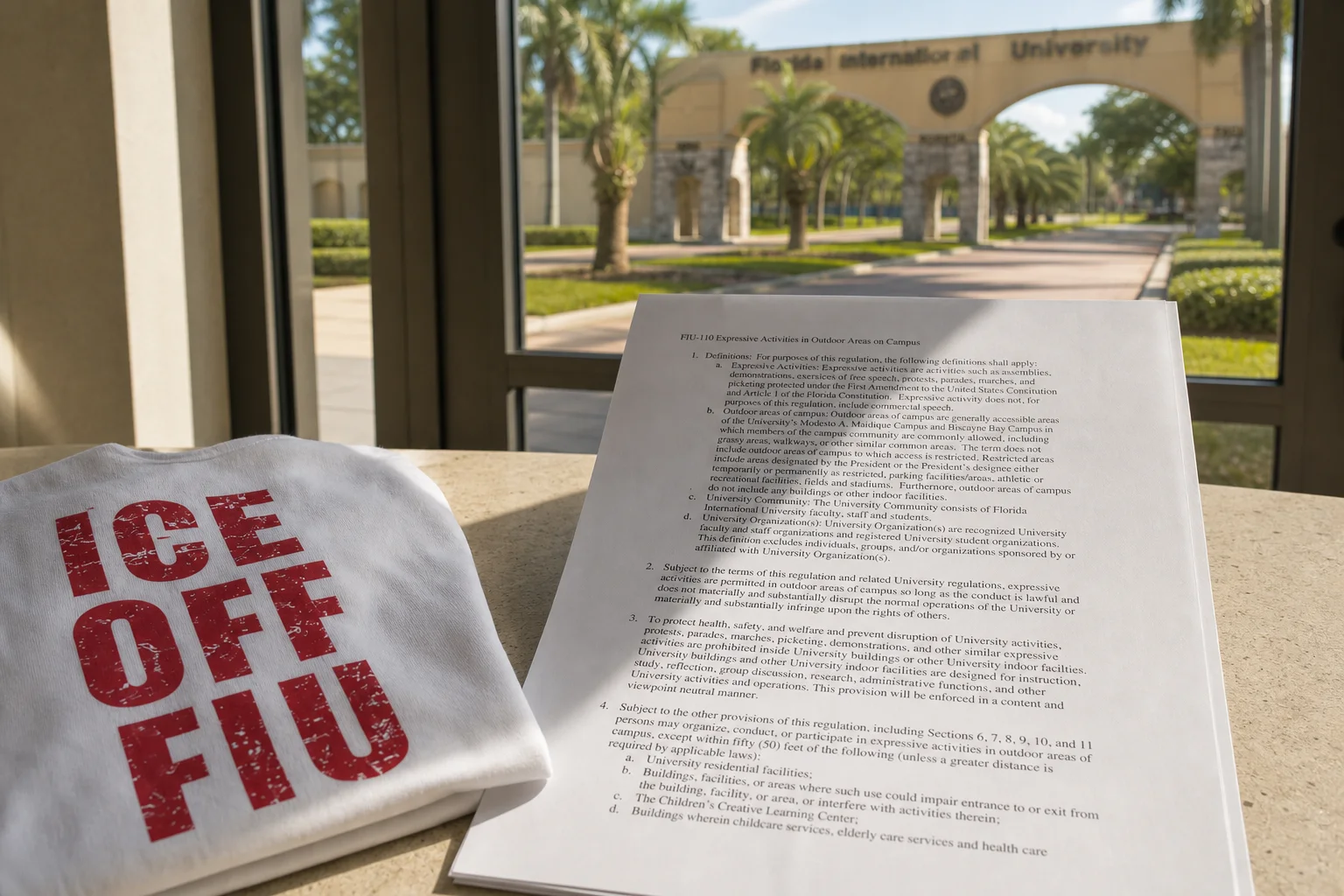
An FIU events official later wrote that the action did not disrupt the event and that the speakers continued their discussion, according to an email reviewed by WLRN. The university nevertheless charged seven students under Regulation 110, which restricts protests, demonstrations, marches, picketing and similar expressive activity inside university buildings.
FIU imposed written reprimands and required each student to record a two-minute video explaining the rule for indoor and outdoor expression and how the student would apply it going forward, according to disciplinary letters reported by WLRN. The students and their lawyers describe that requirement as compelled speech; FIU has characterized it as part of its disciplinary process.
What the lawsuit asks the judge to do
ICEBreakers, the student group that organized the protest, and the seven students filed ICEBreakers v. Nuñez in the Southern District of Florida on August 11. The complaint names FIU President Jeanette Nuñez and four other university officials. The plaintiffs also filed an expedited motion asking the court to block enforcement of the policy against them while the broader civil-rights case continues.
The plaintiffs say a public university cannot punish peaceful, non-disruptive political expression simply because it occurred indoors. Their lawyers compare the protest to landmark student-speech cases involving silent symbols, while also challenging the university’s demand for a video about future compliance.
FIU’s response draws a different line. In a court brief quoted by WLRN, the university said it values free expression and permits lawful expressive activity outdoors. It described Regulation 110 as a narrow, viewpoint-neutral restriction on indoor protests and similar organized conduct in spaces used for instruction, study, administration and university events.
That distinction matters. The judge is not being asked at this stage to approve or reject the students’ anti-ICE message, nor to rule on the merits of FIU’s immigration-enforcement partnership. The question is whether the students have made a strong enough legal and factual showing to pause enforcement of the expression rule until the court can fully hear the case.
Why the ruling matters beyond seven students
The dispute could clarify how broadly a public university can define and restrict “expressive activities” inside campus buildings. A rule written for organized demonstrations can also create uncertainty around coordinated shirts, buttons, flyers, tabling and other political expression that students encounter in ordinary campus life.
It also arrives during an intensifying local debate over FIU’s voluntary participation in the federal 287(g) program, which authorizes designated campus police personnel to perform certain immigration-enforcement functions under ICE supervision. ICEBreakers opposes that agreement. FIU has said its campus-expression policy is applied consistently and in accordance with the First Amendment and state and federal law.
The lawsuit therefore contains two related but separate conflicts: the political dispute over immigration enforcement on campus and the constitutional dispute over how students may protest a public institution’s choices. The injunction motion concerns the second conflict, even though the first explains why the students demonstrated.
What happens next
If Becerra grants the preliminary injunction, FIU could be temporarily barred from enforcing the challenged rule or sanctions against the plaintiffs while the lawsuit continues. If she denies it, the students could continue pursuing the case without that immediate protection. The precise effect will depend on the wording of any order.
Either outcome would be an early ruling, not a final judgment. The case may still proceed through additional filings, evidence and arguments over Regulation 110, the disciplinary videos and the university’s authority to manage indoor spaces. For FIU students returning Monday, however, the first decision could quickly define what political expression is allowed inside campus buildings this semester.


