
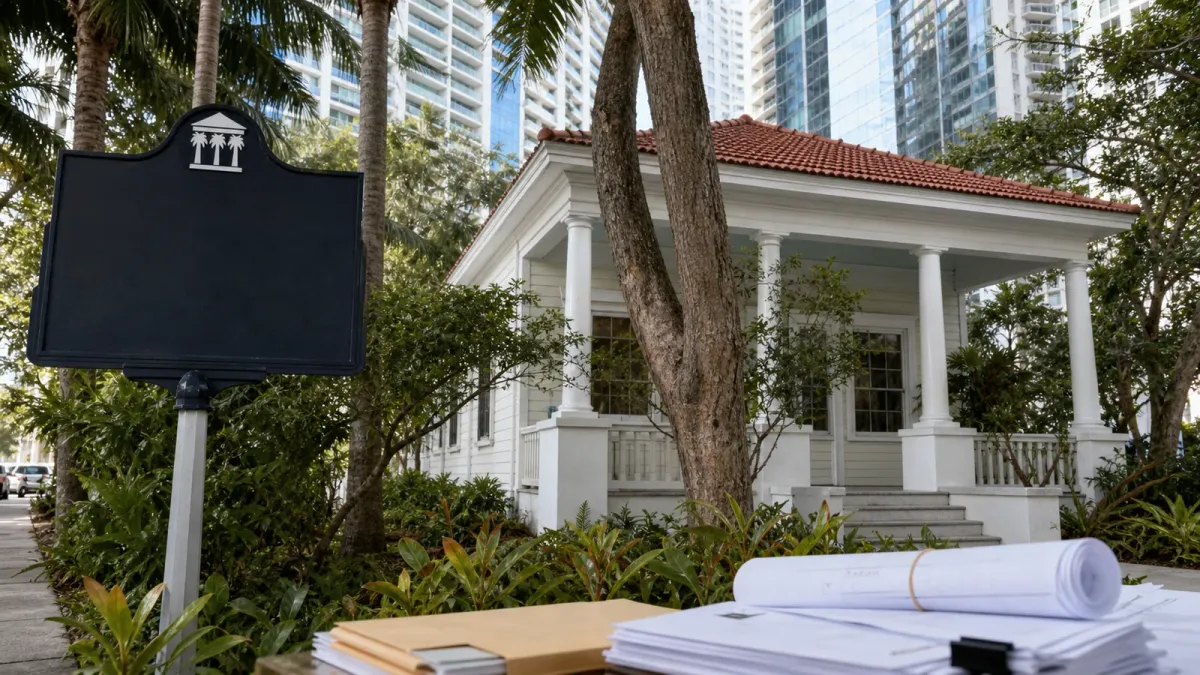
Miami commissioners have approved the first step in a deal that would sell the city-owned Dr. James M. Jackson Office site in Brickell for $2.98 million and put the net proceeds toward Brickell Key Bridge work.
The July 23 vote matters because the 1905 cottage is not just another small parcel in a redevelopment district. City records identify it as the former office and surgical facility of Dr. James M. Jackson, Miami's first resident physician, and as a historic resource recognized by both the National Register of Historic Places and the city's preservation board.
What changed
The City Commission's Resolution R-26-0338 authorizes the city manager to execute a purchase and sale agreement with 1250 BB Asset Co LLC for the property at 190 SE 12 Terrace. The resolution says the purchaser owns adjacent land and that the sale can proceed under a city-charter provision for certain non-waterfront parcels sold to adjoining owners.
The city record sets the purchase price at $2.98 million, equal to the higher of two independent appraisals obtained by the city. It also directs the net proceeds to an account for repair, rehabilitation, maintenance, replacement, planning or evaluation connected to the Brickell Key Bridge.
The public agenda record says the item was adopted with modifications and remained pending final approval as to form and correctness by the city attorney. That means the vote moved the sale forward, but the final legal paperwork still matters.
Why the building is a Miami story
Dade Heritage Trust says the building was originally built in 1905 as Jackson's office and surgery and has served as the preservation group's headquarters since 1978. The National Register nomination describes a one-story frame building with a columned porch, red barrel-tile roof and a history of earlier relocation as Miami grew around it.
Coconut Grove Spotlight reported that the approved plan would move the building from downtown Brickell to Coconut Grove and transfer title to Dade Heritage Trust. The outlet reported that Dade Heritage Trust Executive Director Christine Rupp told commissioners the group had found a long-term preservation solution, while other speakers urged more disclosure about how the building would be protected during a move.
What happens next
The practical question for Miami residents is now twofold: how the city completes the land transaction, and what preservation review follows before the cottage can be moved. Coconut Grove Spotlight reported that the relocation still needs Historic and Environmental Preservation Board approval.
For Brickell, the deal would help clear a small but prominent historic holdout near a fast-changing corporate development area. For Coconut Grove and preservation advocates, it would shift attention to the proposed receiving site, the engineering plan for the 121-year-old structure and whether the public gets enough detail before the next approvals.
For Brickell Key residents and commuters, the bridge funding piece is the clearest immediate public-dollar consequence. The city resolution says the sale proceeds are to be used exclusively for Brickell Key Bridge work or related evaluation, giving the small landmark sale a direct infrastructure afterlife.


