
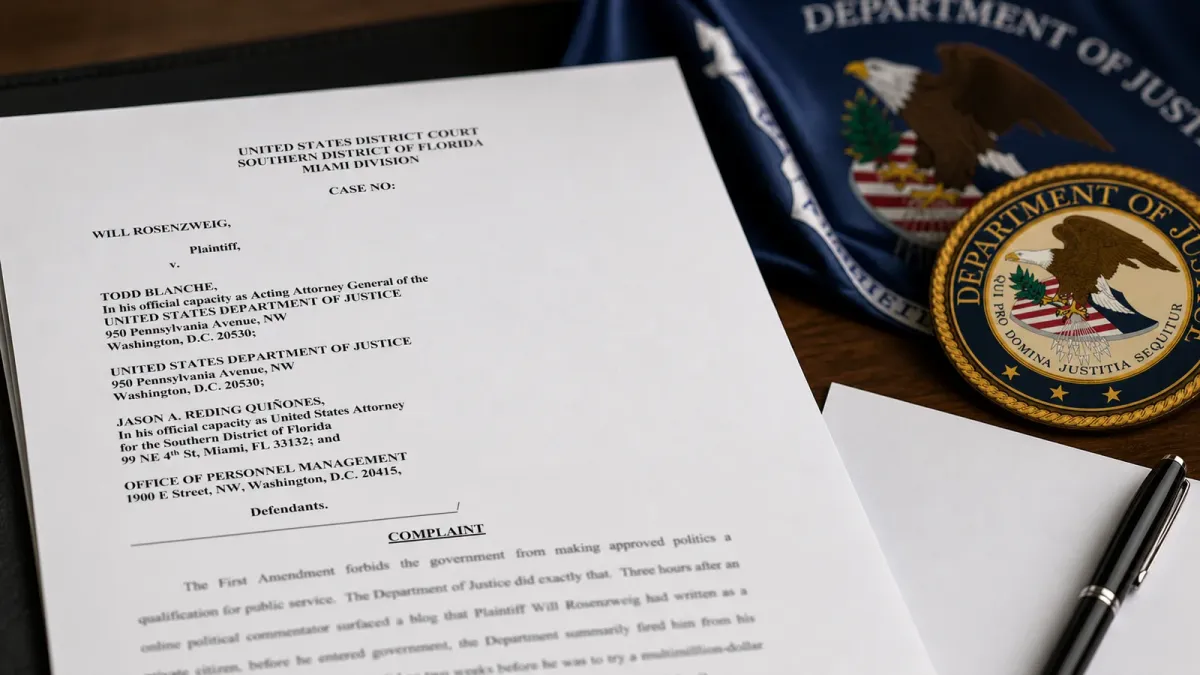
A former Miami federal prosecutor has turned his firing into a new federal lawsuit that asks a local court to decide how far the United States Department of Justice can go when an employee's old political speech becomes newly controversial.
Will Rosenzweig filed the complaint in the U.S. District Court for the Southern District of Florida's Miami Division on August 7, 2026. The lawsuit says the department dismissed him in September 2025 after online posts highlighted a years-old personal blog he wrote before joining the government.
The case matters locally because Rosenzweig worked for five years in the U.S. Attorney's Office for the Southern District of Florida, including on health care fraud cases. The complaint says he was about two weeks away from trying a multimillion-dollar Medicare fraud case when he was removed.
Rosenzweig is now a Miami-based commercial litigation attorney, according to his firm biography. That keeps the story anchored in the same legal market that produced the dispute: a former local federal prosecutor is asking a Miami federal court to review a personnel decision made by national Justice Department leadership.
What the lawsuit claims
The complaint names Acting Attorney General Todd Blanche, the Justice Department, Southern District of Florida U.S. Attorney Jason A. Reding Quiñones and the Office of Personnel Management as defendants. It brings claims under the First Amendment, separation-of-powers principles, the Privacy Act, the Fifth Amendment and the Administrative Procedure Act.
Rosenzweig is asking for reinstatement as an Assistant U.S. Attorney, compensation for losses tied to the firing, attorney's fees and other relief. The complaint says his removal memorandum did not give a reason, and it argues that the timing points to retaliation for private-citizen speech.
The Associated Press reported that a Justice Department spokeswoman declined to comment because the litigation is pending. The allegations have not been tested in court, and the department has not yet filed a detailed public response in the case.
Why Miami readers should care
The filing puts a national constitutional fight inside Miami's federal legal system. The practical question is not only whether Rosenzweig gets his job back. It is whether political statements made before federal service can later be treated as a disqualifier for career prosecutors and other government lawyers.
That issue reaches into the local courts because Southern District prosecutors handle major fraud, corruption, narcotics, immigration and public-corruption cases across Miami-Dade and South Florida. A rule that changes who can keep those jobs, or what speech puts those jobs at risk, could affect recruitment, retention and public trust in federal prosecutions here.
What happens next
The case now moves through the Miami federal docket. The next meaningful steps are service on the defendants, any government motion to dismiss or answer, and a judge's early rulings on whether Rosenzweig's claims can proceed.
For now, the most important distinction is that the complaint is an allegation, not a finding. Rosenzweig has put the Justice Department's personnel decision before a Miami court; the court has not yet decided whether the firing was lawful.


